

CSR vs SSR vs SSG vs ISR vs Hydration: A Practical Guide for Modern Web Development
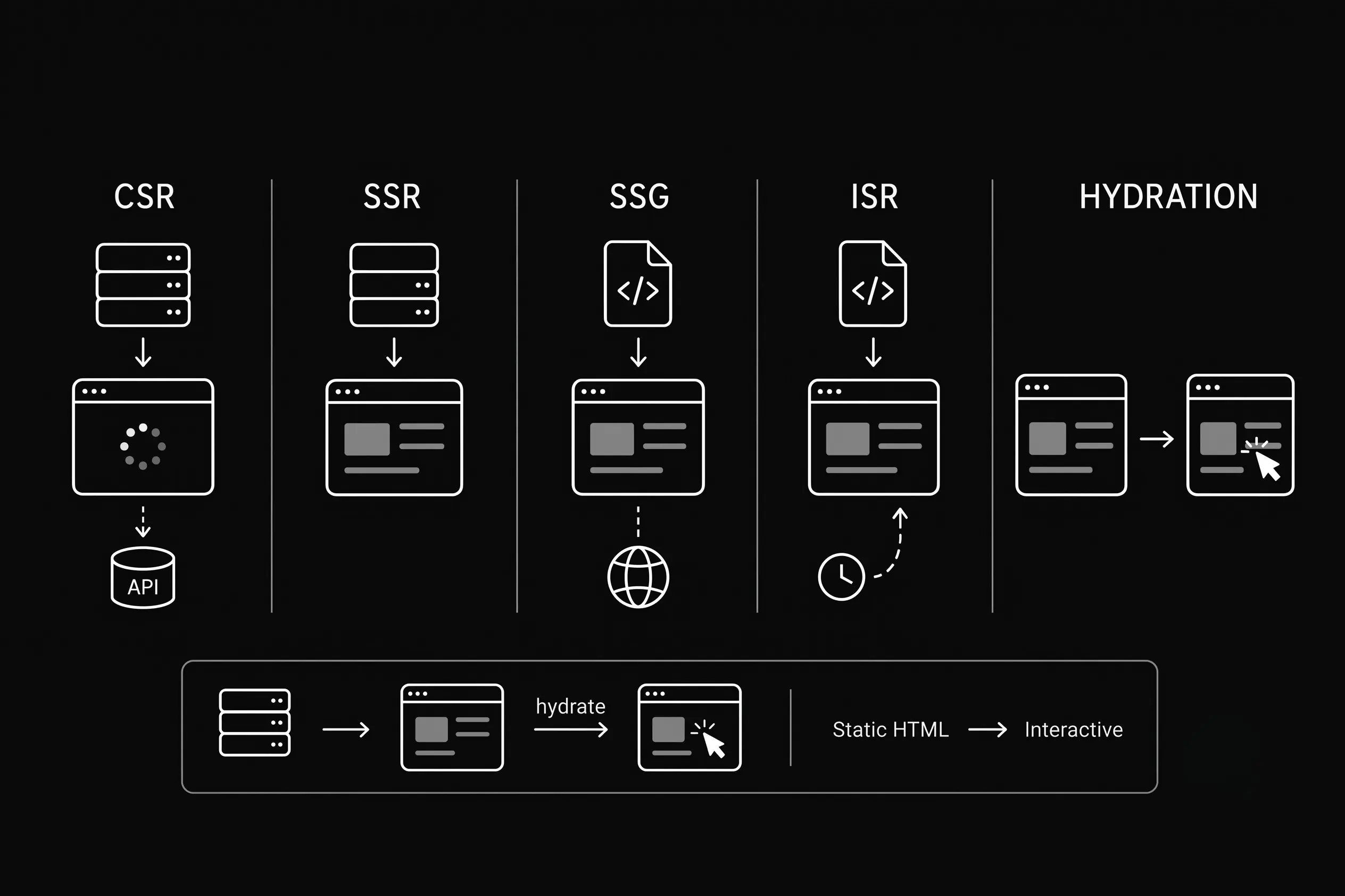
If you’re building with React, Next.js, or Astro, you’ve likely encountered a confusing alphabet soup of acronyms: CSR, SSR, SSG, and ISR. At first glance, they all just mean "show a webpage to a user." But in reality, these rendering strategies determine where your page is built, when it's built, and who does the work.
Choosing the wrong strategy could mean your products never show up on Google, your pages load too slowly, and customers bounce. Let's break everything down in plain English.
How a Web Page Gets to the User
Before comparing strategies, you need to understand the basic lifecycle of a webpage. Most modern apps go through three stages:
-
Build Time: Your source code is compiled and prepared for deployment.
-
Server Processing: The server generates HTML before sending it to the browser.
-
Client Rendering: The browser executes JavaScript and displays the page.
Different rendering strategies simply move work between these three stages. The goal is always the same: deliver content to users as quickly and efficiently as possible.
The Rendering Strategies Explained
Client-Side Rendering (CSR)
Popularized by frameworks like React and Vue, CSR pushes the work to the browser. The server sends a mostly empty HTML file. The browser then downloads the JavaScript, fetches the required data from APIs, and builds the UI. The server does almost nothing, but the user's device does everything.
Server-Side Rendering (SSR)
SSR takes the opposite approach. Instead of asking the browser to build the page, the server generates the full HTML on every single request before sending it to the user. Because the HTML already exists when it arrives, the user sees meaningful content much sooner.
Static Site Generation (SSG)
SSG takes rendering one step earlier. Instead of generating pages when users visit the site, pages are generated during the build process. The resulting HTML files are stored on a CDN and served instantly. No server rendering is needed when a user visits—the page already exists.
Incremental Static Regeneration (ISR)
ISR solves SSG's biggest problem: rebuilding massive websites. Imagine an e-commerce store with 100,000 product pages; rebuilding the whole site for one typo is impractical. ISR generates pages as static HTML, but allows them to be regenerated individually in the background when content changes or a cache expires.
The Cheat Sheet: Which Should You Choose?
There is no universal winner. The best developers select the right tool for the specific problem they are solving.
|
Strategy |
How It Works |
Biggest Advantage |
Biggest Drawback |
Best For |
|
CSR |
Browser builds the page using JavaScript. |
Highly interactive, simple hosting setup. |
Poor initial load time and SEO. |
Dashboards, admin panels, gated web apps. |
|
SSR |
Server builds the HTML on every user request. |
Great SEO, fast perceived load time. |
Higher server workload and infrastructure costs. |
E-commerce, news sites, personalized data. |
|
SSG |
Pages built ahead of time during deployment. |
Extremely fast, cheapest hosting costs. |
Content doesn't update automatically. |
Blogs, documentation, static landing pages. |
|
ISR |
Static pages that rebuild individually when needed. |
SSG speed combined with fresh content. |
Requires complex cache management. |
Large product catalogs, CMS-driven sites. |
What Is Hydration?
Hydration is one of the most misunderstood concepts in modern frontend development.
When a page is rendered on the server using SSR or SSG, the browser initially receives static HTML. It looks correct, but it isn't interactive yet—buttons don't work, and forms won't submit. Hydration is the process of attaching JavaScript behavior to that existing HTML. Think of it like plugging the page into power after it's already been built.
The Hydration Problem
While useful, hydration has a cost. Large applications require significant JavaScript to download before becoming interactive, creating an awkward gap where users can see the page but can't click anything. Modern frameworks are actively solving this through techniques like Partial Hydration, Islands Architecture, and React Server Components to ship less JavaScript and make pages interactive faster.
Final Thoughts
As modern rendering strategies continue to evolve, raw performance is no longer the only thing that matters. The way your website renders content heavily influences how effectively search engines and AI assistants understand your pages.
Want to see how your current setup impacts your online visibility? > Manarah's SEO/GEO Score Analyzer can help. In just a few minutes, you'll get actionable insights into your website's SEO performance, AI search readiness, and specific areas to improve so you can reach a wider audience.
